
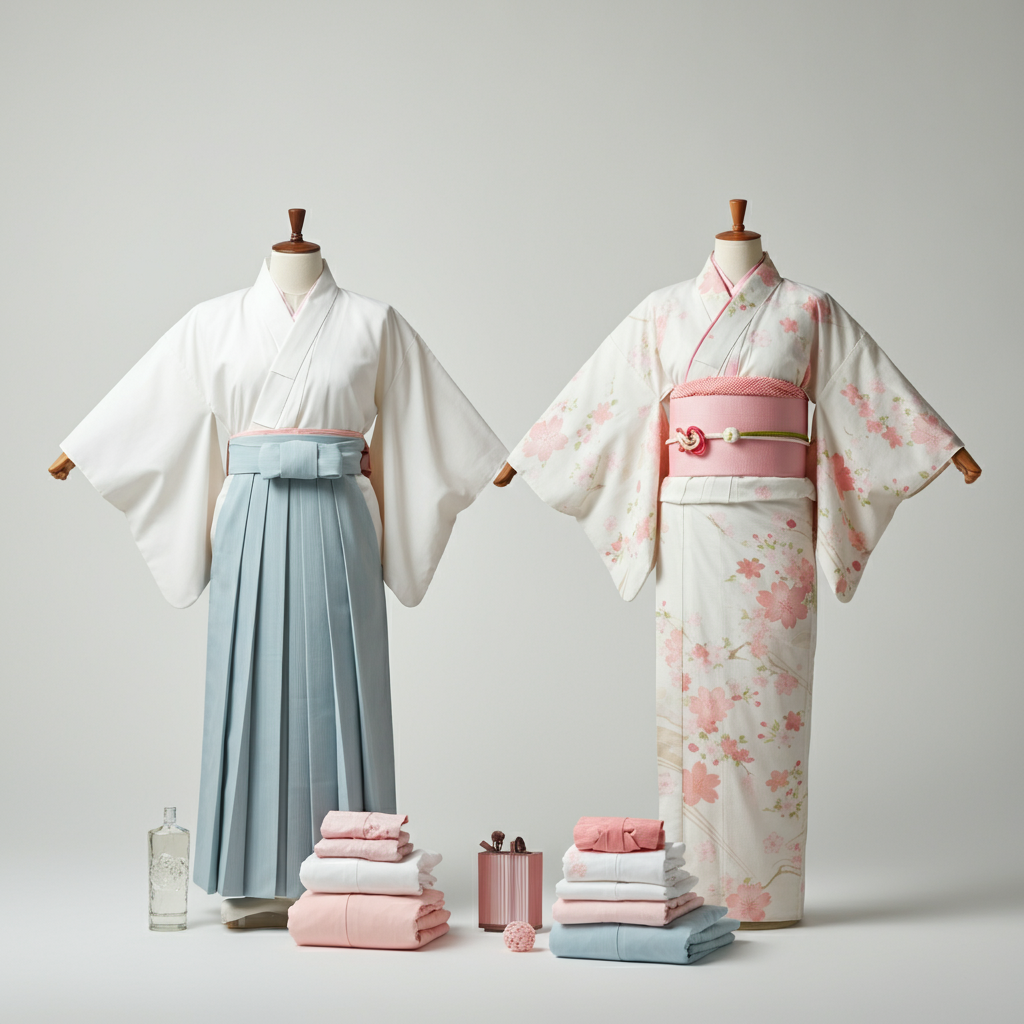
For many Western consumers, the word kimono evokes a beautiful robe with wide sleeves. However, that image isn’t entirely accurate.
It is far from the whole story about authentic kimonos.
Kimonos are not simply decorative garments or interchangeable ‘Japanese robes.’
They are authentic kimonos.
However, authentic kimonos exist within a rich clothing tradition shaped by season and occasion. They reflect social context, craftsmanship, symbolism, and regional history.
Meanwhile, garments Western shoppers group under the kimono label—such as yukata and happi coats—have distinct identities and uses.
For modern retailers, understanding these distinctions is essential. Moreover, it helps customers recognize authentic kimonos and appreciate Japanese craftsmanship without reducing culture to costume.
Kimono, Yukata, and Happi Coats Are Not the Same Thing
One of the most common misconceptions is that every Japanese garment with wide sleeves and a wrap-style front is a kimono. In reality, several garments can look superficially similar while serving very different purposes.
Kimono: A Garment With Deep Cultural Context
The term kimono literally means “thing to wear,” but contemporary kimono culture encompasses a highly developed tradition of dress.
Traditional kimonos are crafted from carefully constructed panels of fabric.
They are worn with an obi, the broad sash that helps create the garment’s distinctive silhouette.
Different types of kimono are associated with different occasions, seasons, ages, levels of formality, and social situations.
A formal kimono worn for a wedding, for example, communicates something very different from a casual garment worn at a seasonal gathering. Patterns, colors, fabric, accessories, and the way a kimono is styled can all contribute to its meaning.
That context is easy to lose when kimono are presented simply as fashion accessories.
Yukata: Lightweight, Casual, and Closely Associated With Summer
Yukata are often called “summer kimono,” but describing them this way can blur an important distinction.
Traditionally, yukata were informal garments associated with bathing and later developed into popular summer clothing. Today, they are commonly worn at summer festivals, fireworks displays, and other relaxed seasonal occasions.
They are generally lighter and less formal than many traditional kimono and are often made from cotton. Their colorful designs and relatively accessible construction have also made yukata particularly popular with visitors to Japan.
For retailers, labeling a yukata accurately helps customers understand why it may be appropriate for a summer festival but not equivalent to a formal kimono.
Happi Coats: Practical, Communal, and Festive
Happi coats are another garment frequently mistaken for kimono.
These short, loose-fitting coats are historically associated with groups, businesses, festivals, and other communal settings. Their bold designs and relatively simple construction give them a very different visual and cultural character from formal kimono.
A happi coat may feature a large emblem, kanji, or other graphic design identifying a festival organization, business, or group. Rather than treating it as another style of robe, retailers can explain its connection to communal identity and celebrations.
That small amount of context can transform a customer’s understanding of what they are buying.
Clothing Can Communicate More Than Style
Another misconception is that kimono patterns are purely decorative.
Japanese textile traditions often use motifs that carry associations with nature, seasons, longevity, prosperity, celebrations, or other ideas. Chrysanthemums, cranes, waves, plum blossoms, bamboo, fans, and other motifs can have cultural or symbolic associations, although their meaning can vary depending on context.
Color can matter, too. Certain combinations or motifs may be particularly appropriate for specific seasons or occasions.
This does not mean every kimono pattern has a single secret meaning. Retailers should avoid presenting symbolism as a rigid code in which every flower or color has one universal translation.
Instead, product descriptions can provide accurate, nuanced context: explain the motif, describe its traditional associations, and acknowledge when interpretations vary.
Craftsmanship Is Part of the Story
A kimono is not simply a piece of fabric cut into a robe.
Traditional kimono production can involve weaving, dyeing, embroidery, painting, resist-dyeing techniques, hand finishing, and other specialized skills. Depending on the garment, textile production and decoration can require considerable expertise.
Techniques such as yuzen dyeing, shibori resist dyeing, and intricate embroidery demonstrate how Japanese textile traditions combine design with highly skilled craftsmanship.
For retailers, highlighting how a garment was made can be far more meaningful than describing it merely as “Japanese-inspired.”
Customers increasingly want to know where products come from, who made them, what materials were used, and why particular techniques matter. Sharing that information respectfully gives craftsmanship the attention it deserves while helping consumers make more informed purchases.
Kimono Are Not Simply Costumes
One of the most persistent Western misconceptions is the idea that kimono are essentially costumes for special occasions, themed parties, or visual performances.
Kimono are clothing. They can be formal or informal, traditional or contemporary, ceremonial or everyday depending on the garment and context. Japanese designers and wearers have also continued to reinterpret kimono in modern ways.
This distinction matters when retailers market kimono-inspired products.
Using a kimono as a fashion reference is not inherently disrespectful. The problem arises when a complex cultural tradition is stripped of its context and presented as an exotic costume, novelty, or generic symbol of “Japan.”
Marketing language can make a substantial difference. A product described with accurate information about its design, construction, and cultural context invites appreciation. A product marketed around stereotypes or “dressing up as Japanese” reinforces them.
Appreciation Versus Cultural Appropriation
The conversation around cultural appropriation can sometimes seem difficult for retailers to navigate. A useful starting point is to distinguish between learning from a culture and reducing that culture to an aesthetic commodity.
Respectful appreciation begins with curiosity and context.
Retailers can:
- Use accurate names for garments.
- Explain differences between kimono, yukata, and happi coats.
- Credit designers, artisans, workshops, and textile traditions where appropriate.
- Provide information about materials, production techniques, and provenance.
- Avoid stereotypes in photography, copy, and advertising.
- Avoid presenting sacred, ceremonial, or culturally significant elements as generic accessories.
- Encourage customers to learn about the culture behind the product rather than simply consuming its visual style.
The goal isn’t to suggest that people outside Japan can never wear kimono or kimono-inspired clothing. In fact, visitors to Japan are often invited to experience wearing kimono or yukata as part of cultural tourism.
The important question is how the garment is represented and understood.
Wearing a yukata to a summer festival while learning how it is traditionally styled is fundamentally different from treating a culturally significant garment as a Halloween costume.
Retailers Have an Educational Opportunity
The modern retail environment gives businesses an unusual ability to provide context at the moment of purchase.
A product page can explain whether an item is a kimono, yukata, or happi coat. A store display can describe the textile technique used to create a pattern. Packaging can introduce the artisan or region associated with a textile. Social media can show how garments are traditionally worn while acknowledging contemporary interpretations.
Even a short explanation can correct a major misconception.
Instead of:
“Japanese robe with beautiful traditional patterns.”
A retailer could explain:
“This lightweight cotton yukata is a casual Japanese garment traditionally associated with summer. Its seasonal motif reflects a long-standing Japanese appreciation for nature and changing seasons.”
The second description doesn’t just sell the product. It gives the customer a reason to understand and value it.
Modern Kimono Culture Is Not Frozen in Time
Respectful education also means avoiding the opposite mistake: treating kimono culture as something that exists only in the past.
Kimono continue to evolve. Contemporary makers, artists, designers, and wearers experiment with fabrics, silhouettes, styling, and ways of incorporating kimono into modern wardrobes.
Traditional craftsmanship can coexist with contemporary fashion.
For retailers, this creates an opportunity to tell a more complete story—one that acknowledges historical traditions without suggesting that Japanese clothing culture is static or exists primarily for Western consumption.
A Better Way to Sell Cultural Products
The strongest retail approach is not to remove culture from the sales experience. It is to provide more of it.
Customers can appreciate beautiful clothing while also learning what makes that clothing meaningful. They can discover why a yukata differs from a formal kimono, what a happi coat represents, why certain motifs appear repeatedly in Japanese textiles, and how skilled artisans bring those designs to life.
That educational approach benefits both consumers and creators.
It helps customers purchase with confidence. It gives craftsmanship greater visibility. It reduces stereotypes. And, most importantly, it treats Japanese clothing traditions as living cultural practices rather than interchangeable decorative themes.
For modern retailers, the lesson is simple: don’t just sell the look—tell the story behind it.
When businesses provide accurate terminology, cultural context, craftsmanship details, and thoughtful guidance, they give customers something more valuable than a product. They give them a way to appreciate Japanese textile traditions with greater understanding and respect.
Leave a Reply